Is there an AI plugin for MuseScore 4?
Yes. Scorehand is a plugin for MuseScore Studio 4 that opens a chat window next to your score. You type what you want ("write a walking bass in bars 1-16", "make the trumpet part easier") and it writes the notes straight into the open score as one undo step. It comes with a free trial of 100 applied edits, then 10 free edits every month.
It is built for the jobs that take an hour of clicking: section voicing, string pads and brass hits, bass lines, simplified parts for students, doubling and transposing lines, writing melodies and exercises, slurs, articulations, dynamics and hairpins. It only changes the parts and bars you ask about.
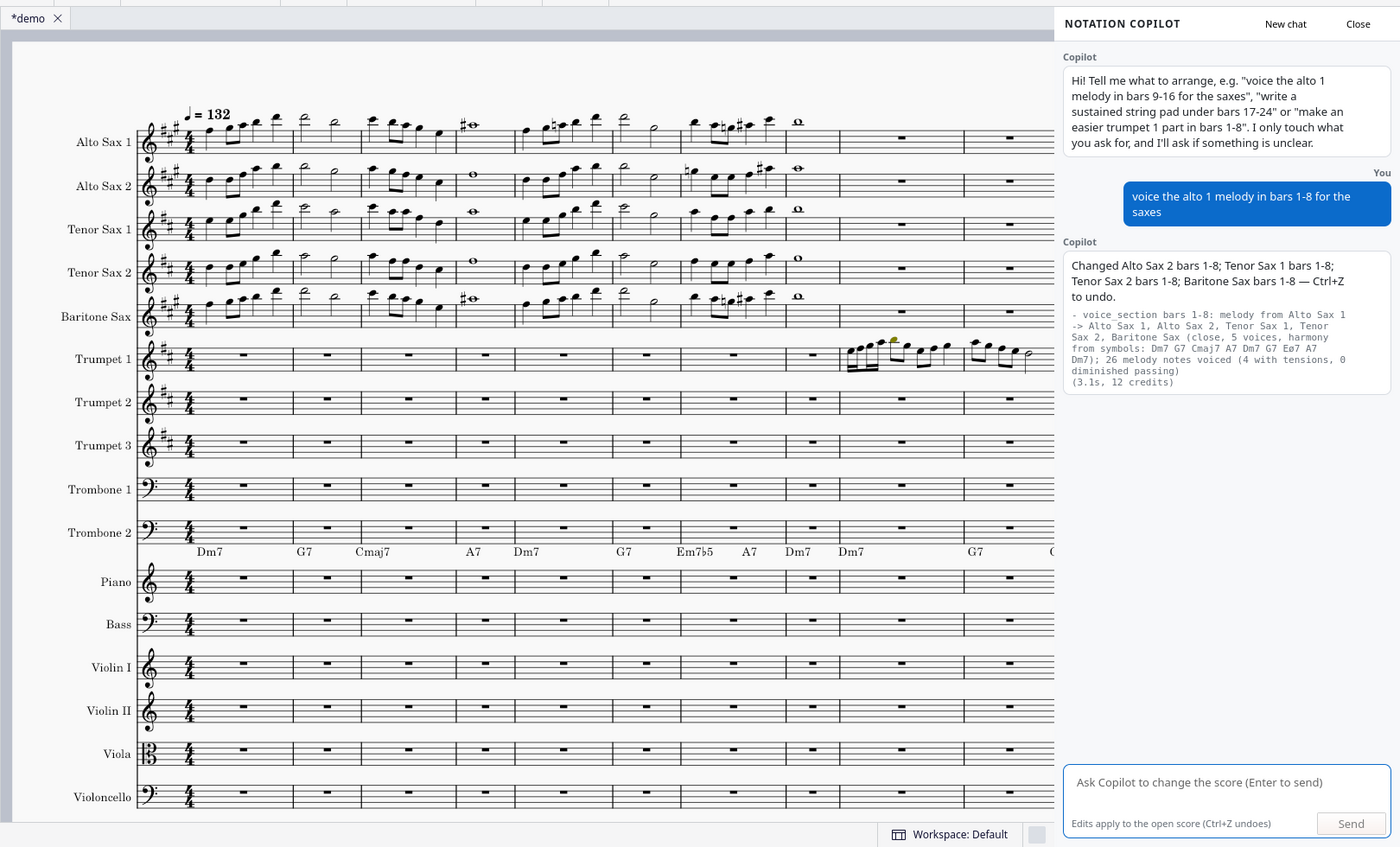
How it works: install in 4 steps
- Get a free key on scorehand.net and click “Download the plugin”. The zip has your key built in, so there is nothing to paste.
- Unzip it into your MuseScore plugins folder, so you end up with a
Scorehandfolder there:
Windows:Documents\MuseScore4\Plugins\
Mac:Documents/MuseScore4/Plugins/(in Finder: Go → Home → Documents)
Linux:~/Documents/MuseScore4/Plugins/ - Restart MuseScore 4, open Home → Plugins and click Scorehand → Enable.
- Open a score and choose Plugins → Composing/arranging tools → Scorehand. Type what you want in the chat.
Example requests and what you get
voice the alto 1 melody in bars 1-8 for the saxes
Result: Alto 2, both tenors and the bari get close-voiced harmony under the melody, built from the chord symbols, each part in its instrument's range.
add a walking bass line in the bass, bars 1-8
Result: Quarter-note walking line: roots on the chord changes, chromatic approach notes in between.
add accents to the flute in bars 5-8
Result: Accents on every note in those bars, nothing else touched.
Honest limits
- It edits the score you have open; it can't add new instruments or staves. Add the staff in MuseScore first (press I), then ask Scorehand to write for it.
- Each request is one undo step: one Ctrl+Z (Cmd+Z on Mac) puts the score back exactly as it was.
- It works in MuseScore Studio 4.x (Windows, macOS, Linux) and needs an internet connection; your score is sent to our server only to make the edit and is not stored.
- Big jobs (more than about 128 part-bars at once) ask you to confirm first. Vague requests get a short question with one-click options instead of a guess.
- It writes from your chord symbols, or from the harmony it reads in the score when there are none. It is a fast first draft: check it by ear like you would a student's or a colleague's part.
Price
A free trial of 100 applied edits, then 10 free edits every month, no card needed (questions and “nothing to change” replies don’t count). For more, Pro ($19/month, 200 edits), Composer ($99/month, 1,000) or pay as you go with credits: A typical edit uses about 150 to 450 credits (1 credit = $0.001), depending on how much music you ask for; big full-band requests can use 750. Clarifying questions are billed like a request; requests that change nothing are not charged. $10 (10,000 credits) is roughly 25 to 65 edits. See pricing.
Try Scorehand on your own score. Free trial: 100 edits, then 10 a month.
Have a PDF or a photo of the music? Convert it to an editable MuseScore file for free, or transpose it for any instrument, then edit it here with AI.
Convert a PDF or photo · Transpose a chart · All Scorehand Free tools
Related questions
- How do I write a walking bass line in MuseScore with AI?
- How do I harmonize a melody for a horn section in MuseScore?
- How do I make an easier version of a part for beginner students in MuseScore?
- Is there an AI composition assistant for MuseScore for students and teachers?
- Can I transpose or double parts in MuseScore just by typing what I want?
- Frequently asked questions