Is there an AI composition assistant for MuseScore for students and teachers?
Scorehand is an AI assistant that works inside MuseScore Studio 4. Students and teachers type what they want written: a melody over given chords, a scale exercise, an accompaniment, a bass line, dynamics. It writes real notation into the score that you can play back, edit by hand and undo with one Ctrl+Z.
It is a helper, not a ghostwriter: it does exactly the step you describe and explains what it changed, so it is easy to use in lessons ("now try it yourself in bars 9-16"). Every note it writes is ordinary MuseScore notation.
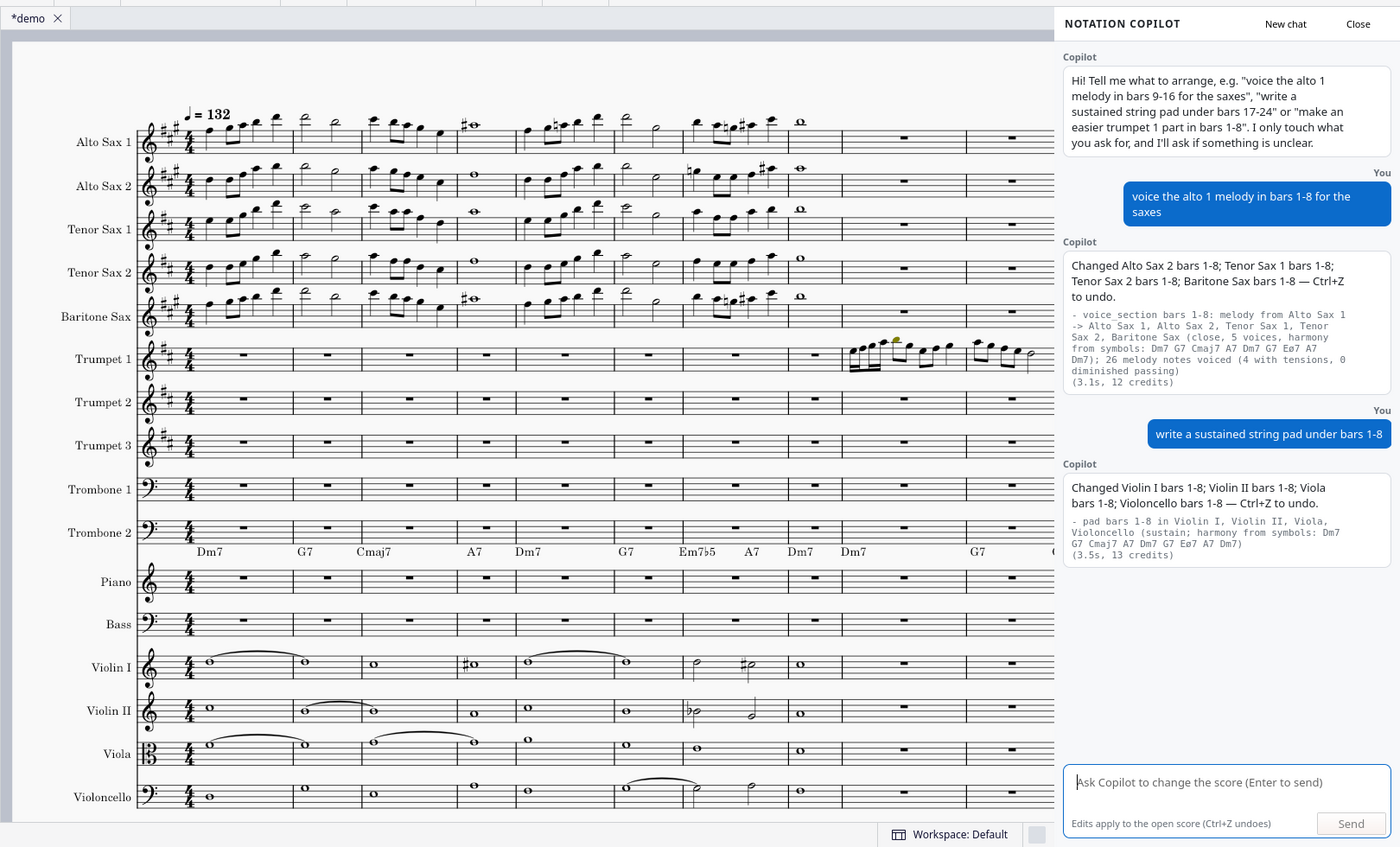
How it works: install in 4 steps
- Get a free key on scorehand.net and click “Download the plugin”. The zip has your key built in, so there is nothing to paste.
- Unzip it into your MuseScore plugins folder, so you end up with a
Scorehandfolder there:
Windows:Documents\MuseScore4\Plugins\
Mac:Documents/MuseScore4/Plugins/(in Finder: Go → Home → Documents)
Linux:~/Documents/MuseScore4/Plugins/ - Restart MuseScore 4, open Home → Plugins and click Scorehand → Enable.
- Open a score and choose Plugins → Composing/arranging tools → Scorehand. Type what you want in the chat.
Example requests and what you get
write a C major scale exercise in quarter notes for the flute in bars 1-4, up and down
Result: Scale written as notes in the flute staff, checked so every bar adds up and stays in range.
add a simple piano accompaniment in the left hand under bars 1-8
Result: Chord tones on the piano's bass staff following the harmony of the melody.
add a crescendo from bar 5 to bar 8 and mark bar 9 forte
Result: Hairpin over bars 5-8 and an f dynamic at bar 9.
Honest limits
- It edits the score you have open; it can't add new instruments or staves. Add the staff in MuseScore first (press I), then ask Scorehand to write for it.
- Each request is one undo step: one Ctrl+Z (Cmd+Z on Mac) puts the score back exactly as it was.
- It works in MuseScore Studio 4.x (Windows, macOS, Linux) and needs an internet connection; your score is sent to our server only to make the edit and is not stored.
- Big jobs (more than about 128 part-bars at once) ask you to confirm first. Vague requests get a short question with one-click options instead of a guess.
- It writes from your chord symbols, or from the harmony it reads in the score when there are none. It is a fast first draft: check it by ear like you would a student's or a colleague's part.
Price
A free trial of 100 applied edits, then 10 free edits every month, no card needed (questions and “nothing to change” replies don’t count). For more, Pro ($19/month, 200 edits), Composer ($99/month, 1,000) or pay as you go with credits: A typical edit uses about 150 to 450 credits (1 credit = $0.001), depending on how much music you ask for; big full-band requests can use 750. Clarifying questions are billed like a request; requests that change nothing are not charged. $10 (10,000 credits) is roughly 25 to 65 edits. See pricing.
Try Scorehand on your own score. Free trial: 100 edits, then 10 a month.
Have a PDF or a photo of the music? Convert it to an editable MuseScore file for free, or transpose it for any instrument, then edit it here with AI.
Convert a PDF or photo · Transpose a chart · All Scorehand Free tools
Related questions
- Is there an AI plugin for MuseScore 4?
- How do I write a walking bass line in MuseScore with AI?
- How do I harmonize a melody for a horn section in MuseScore?
- How do I make an easier version of a part for beginner students in MuseScore?
- Can I transpose or double parts in MuseScore just by typing what I want?
- Frequently asked questions